

How Industrial Videoscopes Help Manufacturers Cut Maintenance Costs
Unplanned equipment downtime is one of the most expensive problems in modern manufacturing. A single unexpected failure on a high-pressure compressor or turbine line can cost tens of thousands of dollars per hour in lost production. Yet many facilities still operate on a reactive maintenance model: fix it when it breaks.
Industrial videoscopes are changing that equation. By enabling detailed, non-destructive inspection of internal equipment surfaces without disassembly, videoscopes put maintenance teams in control.
1. The Hidden Cost of Reactive Maintenance
Most organizations significantly underestimate the true cost of a breakdown. Beyond the direct repair bill: production losses during unplanned downtime, secondary damage caused when a minor defect becomes a catastrophic failure, rush purchasing premiums on replacement parts, overtime labor for emergency repair crews, and quality escapes if defective parts reach the next process stage.
Studies across heavy industry consistently show that reactive maintenance costs 3 to 5 times more per event than a planned intervention at the same defect — simply because of these compounding factors.
2. Where Videoscopes Intervene in the Cost Curve
An industrial videoscope gives maintenance engineers a direct visual window into equipment internals without removing components. A typical inspection through an existing access port takes 15 to 45 minutes. A comparable disassembly-based inspection can take a full shift or longer.
| Inspection Type | Time Required | Equipment Disruption |
|---|---|---|
| Disassembly inspection | 4–16 hours | Full downtime required |
| Videoscope inspection | 15–60 minutes | Partial or no downtime |

3. Predictive Maintenance: Catching Defects Before They Cascade
A structured PdM videoscope program works like this:
- Baseline imaging — Document the condition of critical components at a known-good state
- Interval inspections — Re-inspect at defined intervals tied to operating hours
- Trend analysis — Compare current images against baseline to detect progression
- Condition-based intervention — Schedule maintenance only when actual condition data justifies it
4. Industry-Specific Cost Impact Examples
Power Generation: Gas turbine operators using regular borescope inspections report extending hot section component intervals by 15–25%, reducing annual MRO spend substantially.
Automotive Manufacturing: In-process videoscope checks of cylinder bores and weld assemblies catch casting defects and machining errors before parts advance further down the line.
Oil & Gas: Videoscope inspection allows operators to complete regulatory inspections faster, with less process disruption, and with better documentation than manual methods.
Aerospace MRO: Operators who invest in high-resolution videoscopes with measurement capability reduce the frequency of engine removal events — one of the most expensive line items in aircraft maintenance.
5. Choosing the Right Tool for Cost Efficiency
- Durability and IP rating — A ruggedized instrument that survives the shop floor environment pays back far more than a fragile unit requiring frequent servicing
- Image quality — Higher resolution means defects are caught earlier, at a smaller (and cheaper-to-fix) size
- Measurement capability — Quantitative data on defect dimensions supports better repair-vs-replace decisions
- Ease of use — Instruments that technicians can operate confidently encourage consistent use of the inspection program
Conclusion
The financial case for industrial videoscope inspection is straightforward: catching a 2mm crack costs far less than managing the failure it becomes. For manufacturers looking to reduce maintenance expenditure without compromising equipment reliability, a well-implemented videoscope inspection program is one of the highest-ROI investments available.
Need a reliable industrial inspection tool?
Browse our industrial borescopes and videoscopes — designed for NDT, pipeline, and machinery inspection in demanding environments.
Shop industrial borescopes →Need a reliable industrial inspection tool?
Browse our industrial borescopes and videoscopes — built for NDT, pipeline, and machinery inspection in demanding environments.
Shop industrial borescopes →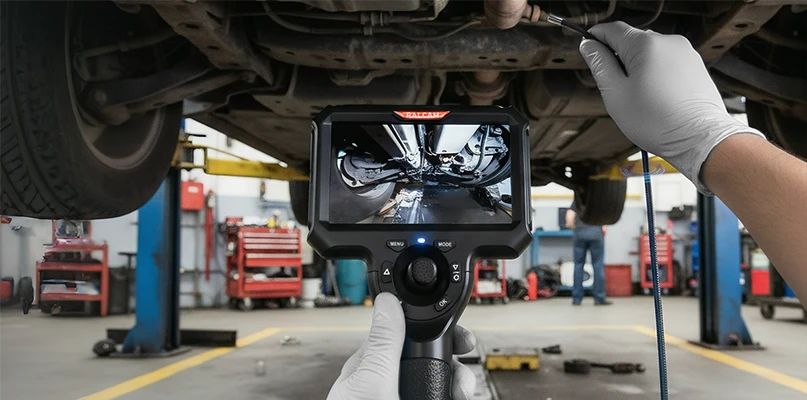
Leave a comment