
Unveiling the Mysteries of the Engine: The Role of Inspection Borescopes in Automotive Maintenance
Engine problems are among the costliest surprises a vehicle owner can face. Without the right tools, diagnosing internal engine issues often means expensive disassembly — hours of labor before a mechanic even confirms what the problem is. Inspection borescopes change that equation entirely, giving technicians and serious DIYers a direct view inside the engine without removing a single bolt.
What Is an Inspection Borescope?
An inspection borescope is a slender, flexible camera tool designed to access confined spaces that are otherwise invisible during routine maintenance. In automotive applications, it threads through spark plug holes, oil filler caps, or intake ports to deliver a real-time view of cylinder walls, valve seats, pistons, and other internal components.
Modern automotive borescopes transmit HD video to a built-in screen or connected device, allowing mechanics to document findings with photos and video clips. This turns subjective judgment into evidence-based diagnosis.
The Automotive Borescope Camera: More Than a Camera on a Stick
At its core, an automotive borescope camera combines a high-resolution image sensor, adjustable LED illumination, and a flexible or semi-rigid probe. Key components include:
- Image sensor: Typically 1080p or higher for clear identification of micro-cracks, scoring, and carbon deposits
- LED ring lights: Adjustable brightness to handle reflective metal surfaces inside cylinders
- Flexible probe: Usually 5.5 mm to 8.5 mm in diameter, allowing entry through standard spark plug ports
- Display unit: A handheld monitor showing live feed with recording capability
When to Reach for an Automotive Endoscope
An automotive endoscope becomes essential when the inspection path has tight bends or irregular geometry. Rigid probes cannot follow curves; a flexible endoscope can. For inspecting behind manifolds, inside turbocharger housings, or deep into transmission tunnels, the endoscope’s articulation is what makes the difference between a useful view and no view at all.
What Inspection Borescopes Reveal
- Cylinder wall scoring: Linear scratches from piston ring failure or insufficient lubrication
- Carbon buildup: Thick deposits on piston crowns and valve faces, common in direct-injection engines
- Valve damage: Burnt edges, cracks, or improper seating that cause compression loss
- Coolant intrusion: White residue indicating a head gasket leak before it becomes a full coolant loss event
- Foreign object debris: Broken ring fragments or metal shavings that signal imminent failure
Step-by-Step: How to Inspect a Cylinder with a Borescope
- Prepare the engine: Ensure the engine is cool and the vehicle is on a stable, level surface. Disable the ignition to prevent accidental cranking.
- Choose the entry point: The spark plug port is the most common access point. Remove the spark plug from the cylinder you want to inspect.
- Insert the probe slowly: Guide the borescope probe straight down into the cylinder, keeping movement smooth to avoid scratching the cylinder wall.
- Rotate and survey: Once at depth, rotate the probe to view all 360 degrees of the cylinder wall. Move the probe up and down to cover the full stroke range.
- Document findings: Capture still images and short video clips of any areas showing wear, deposits, or damage.
- Repeat for other cylinders: Compare findings across cylinders — uneven wear patterns often indicate specific mechanical issues.
- Reinstall the spark plug: Torque to specification after inspection is complete.
What to Look For When Buying an Automotive Borescope
- Probe diameter: 5.5 mm fits most standard spark plug holes; 8.5 mm provides better image quality but limits access points
- Articulation: Two-way or four-way steerable tip dramatically improves visibility in complex cavities
- IP rating: Look for IP67 or higher — the probe will be exposed to oil, coolant, and combustion residues
- Display resolution: At least 1080p to distinguish fine surface detail such as hairline cracks or early-stage scoring
- Cable length: 1 meter is sufficient for most passenger vehicles; commercial or larger engines may require 1.5–2 meters
- Recording format: On-device SD card storage is preferable to phone-dependent systems for workshop use
Conclusion
The inspection borescope has shifted from specialty tool to essential workshop equipment. For any technician or DIY mechanic who wants accurate diagnosis without unnecessary teardown, investing in a quality automotive borescope is one of the most cost-effective decisions available.
Ready to see inside your engine?
Shop our automotive borescopes — built for precision engine inspection, from spark plug checks to turbo diagnostics.
Shop automotive borescopes →Looking for the right borescope?
Browse the full Ralcam range — industrial and automotive inspection cameras for every job.
Shop all borescopes →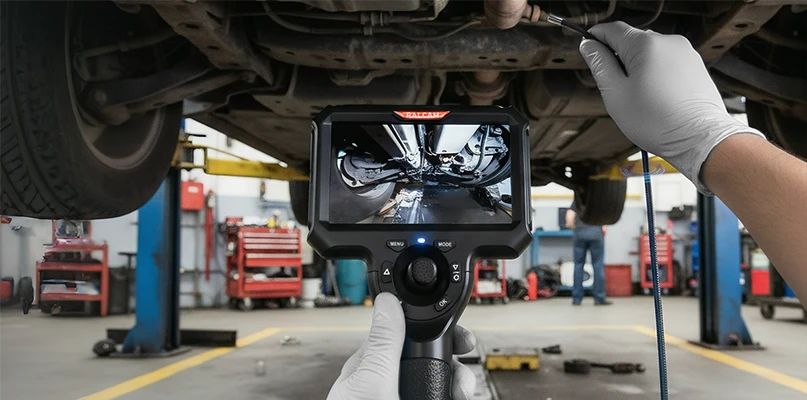
Leave a comment