

The Role of Steering Borescopes in Automotive Repair and Maintenance: A Game-Changer for Precision Diagnostics
Diagnosing vehicle problems accurately without disassembly is no longer reserved for specialized laboratories or dealership-level equipment. The steering borescope — a camera-equipped inspection tool with a remotely controllable tip — has made precision internal diagnostics accessible to independent repair shops and serious vehicle owners alike.
What Is an Automotive Borescope?
An automotive borescope is a slender, camera-equipped inspection tool that allows technicians to visually access and assess internal sections of vehicles. The probe — typically 5.5 mm to 8.5 mm in diameter — inserts through existing access points such as spark plug holes, oil filler ports, or dipstick tubes, transmitting high-resolution live video to an integrated display.
Steering versions take this further. Instead of a fixed-angle tip, a steerable borescope allows the camera head to pivot — typically in two or four directions — via a thumb joystick, enabling active navigation around obstacles without withdrawing and reinserting the probe.
How Steering Borescopes Revolutionize Vehicle Diagnostics
Traditional visual inspections often required dismantling engines or other assemblies just to confirm internal conditions. Steering borescopes eliminate most of this overhead:
- Non-destructive inspections that prevent unnecessary component removal
- Direct visualization inside cylinders, gearboxes, pipes, and manifolds
- Rapid identification of wear, carbon buildup, valve damage, or foreign object debris
- Evidence capture — photos and video — that supports repair authorization and documentation
Greater Precision in Hard-to-Reach Areas
Standard borescopes offer basic visibility but a fixed forward-looking perspective. Steering borescopes add directional control, allowing examination of surfaces at oblique angles — needed to assess valve seat condition, turbocharger blade erosion, or piston crown carbon deposits from above.
- Pinpoint cracks in cylinder heads or faulty valve seats without removing the cylinder head
- Examine turbocharger blades, injector tips, and cooling passages from multiple angles
- Access transmission tunnels and inspect gear surfaces without a teardown
Common Automotive Applications
- Engine cylinder inspection: Look for scoring, pitting, or abnormal carbon buildup without removing the cylinder head.
- Exhaust and intake systems: Spot obstructions, catalyst damage, or deterioration inside long pipe runs.
- Transmission diagnostics: Identify metal shaving accumulation or gear surface damage through access ports.
- Turbocharger inspection: Check compressor and turbine blade condition — critical for high-mileage turbocharged engines showing unexplained boost loss.
- Pre-purchase vehicle inspection: Provide documented evidence of internal engine condition before committing to a used vehicle purchase.
The Inspection Process: How It Works in Practice
- Plan the entry point: Identify the best access — spark plug holes for cylinder inspection, oil cap for upper engine, dipstick tube for lower engine sump area.
- Insert the probe carefully: Guide the camera to navigate bends using the steering joystick. Avoid forcing the probe against hard surfaces.
- Examine and record: Observe the high-resolution feed. Capture still images and short video clips of all areas of interest.
- Analyze findings: Review visuals systematically for cracks, scoring, leaks, corrosion, or foreign debris.
- Document and share: Use captured media to inform repair discussions, create service records, or provide customers with visual evidence of findings.
Key Advantages for Automotive Professionals and DIYers
- Faster turnaround: Confirm or rule out internal damage in minutes, reducing unnecessary teardown and labor hours.
- Cost accuracy: Diagnose precisely before ordering parts.
- Evidence-based reporting: Recorded images and video allow mechanics to show customers exactly what was found.
- Preventative maintenance: Detect developing issues before they require major repair intervention.
Tips for Effective and Safe Use
- Inspect the probe for damage before each use.
- Keep the lens clean; oil or coolant residue on the camera tip significantly reduces image quality.
- Use the steering control gradually in confined spaces to avoid snagging on engine components.
- Store the borescope in its protective case after use to prevent probe damage and lens scratches.
- For turbocharged or diesel engines, allow the engine to cool fully before inserting the probe near exhaust-side components.
Conclusion
Steering borescopes have redefined what a thorough vehicle inspection looks like. The combination of non-destructive access, directional camera control, and built-in documentation capability means that accurate engine diagnostics no longer require expensive teardown. For any repair professional or hands-on vehicle owner who wants to diagnose confidently and document clearly, the steering borescope belongs in the toolkit.
Ready to see inside your engine?
Shop our automotive borescopes — built for precision engine inspection, from spark plug checks to turbo diagnostics.
Shop automotive borescopes →Looking for the right borescope?
Browse the full Ralcam range — industrial and automotive inspection cameras for every job.
Shop all borescopes →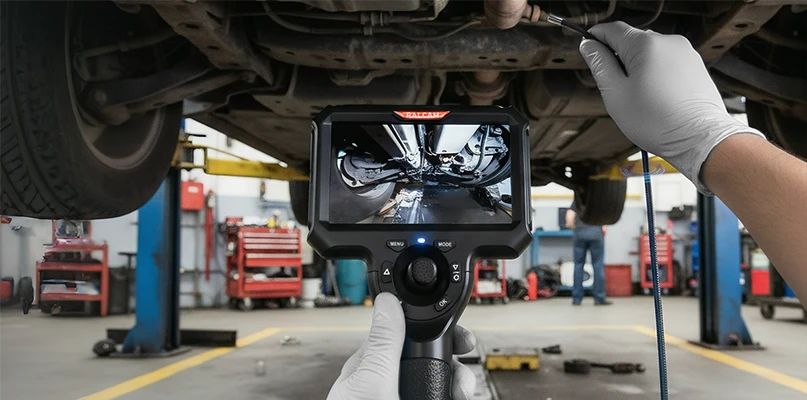
Leave a comment