

What Is an Endoscope? Beginner’s Guide to Principles & Types
When you first hear the word endoscope, you might think of hospitals and medical check-ups. But in fact, endoscopes play a vital role in many industrial applications too. If you are new to this field, this article is your first step to understanding what an endoscope is, the principle behind it, and the difference between steerable and non-steerable endoscopes.
What Is an Endoscope?
An endoscope is a slim inspection tool with a camera and built-in light. It allows technicians to look inside confined spaces — such as pipes, engines, turbines, and machinery — without dismantling them.
👉 Professionals use our industrial endoscopes for high-resolution imaging, flexible control, and efficient fault detection.
The Principle of Endoscopes
The principle of an endoscope is straightforward but powerful:
- A tiny camera captures images or videos from the probe's tip.
- LED lights illuminate dark, enclosed spaces.
- The images are transmitted to a screen in real time.
- Advanced models can record, photograph, and even measure defects.
This makes endoscopes indispensable for maintenance, quality inspection, and troubleshooting.
Steerable vs. Non-Steerable Endoscopes
Non-Steerable Endoscopes
- Probe cannot bend.
- Moves only straight forward.
- Cost-effective and simple to use.
- Suitable for straightforward pipe or cavity inspection.
Steerable Endoscopes
- Probe tip can be controlled (often 210° or more).
- Navigate bends, branches, and hidden corners.
- Crucial for complex inspections like aircraft engines, car cylinders, and HVAC ducts.
👉 For a versatile solution, the F606B steerable industrial endoscope combines 4-way 210° articulation, real-time imaging, and measurement capability, making it ideal for demanding industrial environments.
FAQ: Beginner's Questions About Endoscopes
Q1: What industries use endoscopes most often?
A: Aerospace, automotive, energy, and manufacturing are the top users for inspection and preventive maintenance.
Q2: Do I need a steerable endoscope?
A: If you're only checking straight pipes, non-steerable models may be enough. For engines, turbines, or complex machinery, steerable models are essential.
Q3: Can an endoscope take photos and videos?
A: Yes, most modern endoscopes can capture both images and video recordings. Some even allow temperature measurement and defect analysis.
Choose Your First Endoscope — Ralcam Recommendations
Based on what you just learned, here are the most common starting points by use case:
- Car engine inspection (first borescope): Ralcam N308S — 2-way articulating, 3.5" screen, $109.99
- Phone-connected, lightweight: Ralcam F408A — plug into iPhone or Android, $125
- Most versatile professional scope: Ralcam F606B — 4-way 210°, 4.3" screen, 6-hour battery, $259
- Industrial / aviation grade: Ralcam M6X — 4-way 360°, 5" IPS screen, 1080p, $359.99
- UV crack and weld detection: Ralcam M608U — UV LED, 4-way 360°, NDT-ready, $709.40
Not sure which fits your job? Read the Borescope Buyer's Guide or contact our team for a direct recommendation.
Conclusion: Your First Step to Understanding Endoscopes
By now, you should know what an endoscope is, how it works, and the difference between steerable vs non-steerable endoscopes.
This basic knowledge is the foundation for choosing the right tool for your inspection tasks. Whether you're in automotive maintenance, HVAC servicing, or heavy industry, the right endoscope will save you time, reduce costs, and ensure higher accuracy.
Find the right inspection camera for your job
From DIY home use to professional-grade inspection, explore our full range of borescopes and endoscopes.
Browse all products →Looking for the right borescope?
Browse the full Ralcam range — industrial and automotive inspection cameras for every job.
Shop all borescopes →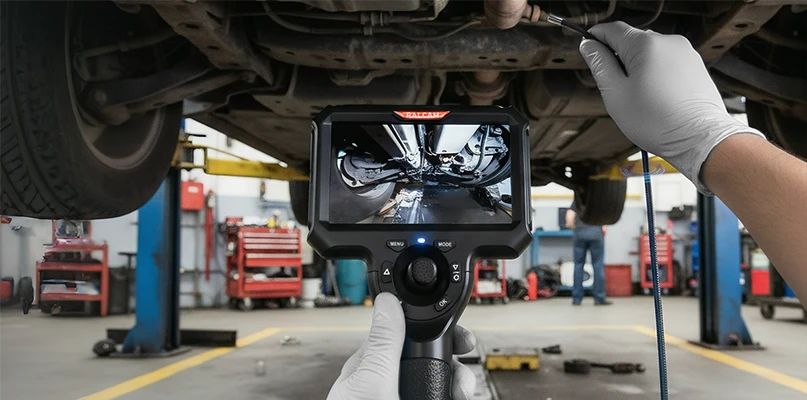
Leave a comment