

Why Your Maintenance Team Is Flying Blind (And How to Fix It)
Most maintenance programs are built on assumptions. Scheduled service intervals assume wear happens at a predictable rate. Visual surface inspections assume that what's visible on the outside reflects what's happening inside. Industrial endoscopes exist to close that gap.
The Problem with "Scheduled" Everything
Scheduled maintenance made sense when the alternative was no maintenance at all. For high-value capital equipment — turbines, compressors, heat exchangers, propulsion systems — it breaks down. Average failure rates don't describe any individual machine. Condition-based maintenance addresses this by replacing calendar schedules with evidence. The challenge has always been gathering that evidence without the cost and disruption of disassembly. That's what industrial endoscopes do.

What Inspection Actually Reveals
An endoscope inserted into an operating envelope doesn't just confirm whether damage has occurred. Used systematically over time, it builds a longitudinal picture of how a specific asset is aging.
In gas turbines, periodic borescope inspection tracks the progression of thermal barrier coating degradation on hot-section components. In reciprocating compressors, cylinder liner wear is visible through the valve ports. In heat exchangers, tube interior surfaces tell the story of fouling, erosion, and early corrosion.
None of this information is available from the outside. All of it changes the quality of the maintenance decisions that follow.
The Real Cost of Not Knowing
Unplanned downtime in process industries typically costs two to five times more than equivalent planned downtime. A single unplanned shutdown of a large centrifugal compressor can generate losses in the hundreds of thousands before the root cause is even identified. If a periodic endoscope inspection program — even one conducted quarterly — identifies developing damage early enough to schedule a controlled intervention, the avoided loss can justify years of inspection program costs.

Building an Inspection Program That Works
An endoscope on a shelf adds no value. The instrument's value comes from a program: defined inspection intervals, documented baseline images for comparison, trained operators who know what they're looking at, and a reporting workflow that turns observations into maintenance actions.
Best-practice programs establish visual baselines for critical assets during initial inspection, define acceptance criteria in advance, and connect inspection findings to the work order system so that observations automatically generate follow-up actions.
Conclusion
Flying blind is a choice — usually an unconscious one, inherited from maintenance practices developed before better options existed. Industrial endoscopes make direct internal inspection practical, affordable, and repeatable for almost any enclosed asset. The question worth asking is not whether you can afford to implement an inspection program. It's whether you can afford the alternative.
Need a reliable industrial inspection tool?
Browse our industrial borescopes and videoscopes — designed for NDT, pipeline, and machinery inspection in demanding environments.
Shop industrial borescopes →Need a reliable industrial inspection tool?
Browse our industrial borescopes and videoscopes — built for NDT, pipeline, and machinery inspection in demanding environments.
Shop industrial borescopes →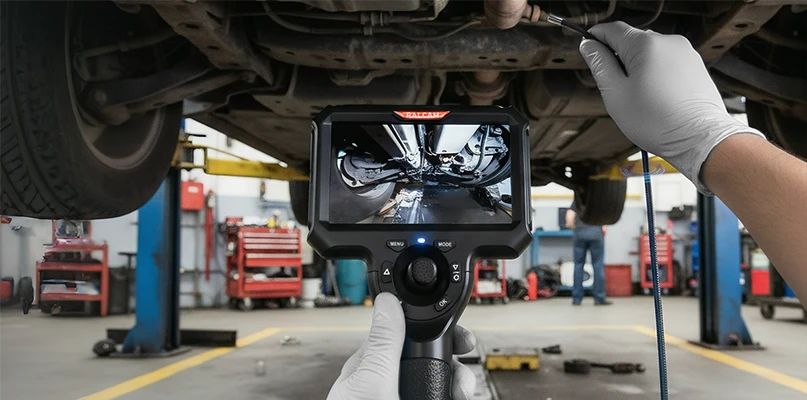
Leave a comment