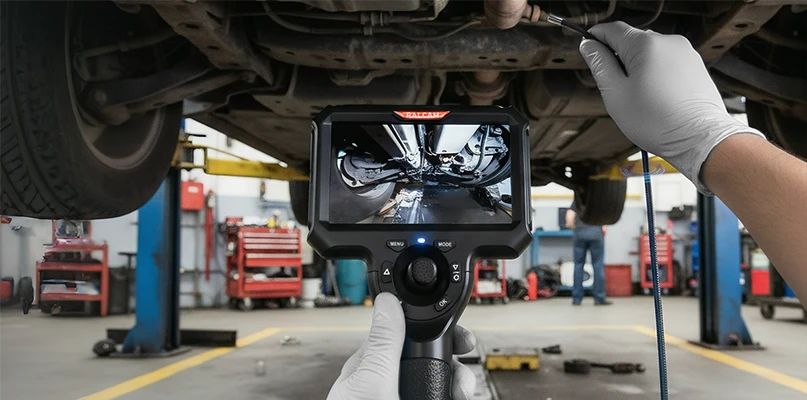
What Is an Articulating Borescope?
A borescope is a camera on the end of a thin tube. An articulating borescope adds one thing: the tip bends on command. Instead of only seeing whatever happens to be straight ahead, you steer the camera to look sideways, backwards, or around a corner — without pulling the probe out and starting again.
That single capability is what separates a tool that confirms what you already suspected from one that finds what you did not know to look for.
Why a Fixed-Tip Borescope Falls Short
Picture inspecting a cylinder through a spark plug hole. A fixed camera shows you the patch of piston crown directly below the opening. The cylinder wall behind you, the underside of the intake valve, the far side of the bore — all invisible. You can wiggle the probe and guess, or you can pull it out, rotate it, and push it back in, hoping the angle is better this time.
An articulating tip removes the guessing. You insert once and sweep.
How the Bending Section Works
Behind the camera head sits a short articulation section — a series of linked segments with control wires running back to the handle. Pulling one wire shortens that side of the section and the tip curves toward it. A 2-way scope has one opposing pair of wires, so it bends in a single plane. A 4-way scope has two pairs at right angles, so any combination of the two gives you a full cone of movement.
This section is also the wear point. Those wires are under repeated tension every time you steer, which is why articulation range degrades before image quality does on a heavily used scope.
2-Way vs 4-Way: What Actually Changes
| 2-Way | 4-Way | |
|---|---|---|
| Movement | Bends in one plane — up and down, or left and right | Bends independently in all four directions |
| Control | Thumb wheel or damping knob | Joystick or rocker |
| To change plane | Rotate the whole probe from the handle | Nothing — steer from where you are |
| Holding an angle | Damping knob holds it mechanically | Joystick returns to centre on most models; some lock |
| Cost | Lower | Higher — more wires, more complex tip |
When 4-Way Actually Earns Its Price
The honest answer: 2-way handles most jobs. If your inspections are largely straight-in — a cylinder through a spark plug hole, a drain run, a duct — a 2-way scope does the work for less money, and rotating the probe covers the second axis well enough.
4-way pays for itself when the target is off-axis and you cannot rotate freely. Three situations where that is true:
- You need to look back along a surface you have already passed. A turbine blade trailing edge, or the roof of an intake port viewed from inside the cylinder. A 2-way tip cannot fold back on itself in the plane you need.
- The probe is wedged and cannot be rotated. In a tight bore the cable binds; twisting the handle no longer twists the tip.
- You are documenting a full surface in one pass. Sweeping a cavity with 4-way control is one continuous motion; with 2-way it is insert, rotate, reinsert, repeated.
Outside those, the extra cost buys convenience rather than capability.
Frequently Asked Questions
Is an articulating borescope worth the extra cost over a fixed one?
If you inspect the same straight bore repeatedly, probably not. If you are diagnosing unfamiliar faults, or the surface you need to see is not directly in front of the probe tip, articulation pays for itself the first time it saves a teardown.
Does the tip hold its position once bent?
On 2-way models with a damping knob, yes — the mechanism holds the angle you set so the image stays still while you photograph it. Joystick-controlled 4-way models typically spring back toward centre when released; check the individual product page.
What is the difference between a borescope and an endoscope?
In practice the terms are used interchangeably for industrial tools. “Endoscope” is more common in medical and veterinary contexts; “borescope” is the usual term for engineering and automotive work. The hardware is the same idea.
How long does the articulation section last?
Well-built probes handle tens of thousands of bend cycles. Because the articulation section wears before the rest of the instrument, scopes with a detachable probe or a modular design let you replace just that part instead of the whole unit.
Next Step
Articulation is one of five decisions. For the rest — probe diameter, cable type, built-in screen versus phone, and matching a model to your use case — work through the Borescope Buyer's Guide, or compare every model side by side in the full spec table.
Ready to browse? See the 2-way articulating borescopes or the 4-way articulating borescopes.