

Fleet Maintenance and the Endoscope — Managing Engine Health Across Multiple Vehicles
Running a commercial fleet is an exercise in controlled uncertainty. Each vehicle is a depreciating asset generating revenue while consuming maintenance resources. The objective is to keep each asset generating revenue for as long as possible at the lowest sustainable cost.
The Fleet Maintenance Information Problem
Fleet vehicles accumulate mileage faster than private vehicles, often under harder conditions. The result is that identical vehicles with identical odometer readings can be in radically different condition depending on how they've been operated. A standard service history review and visual inspection don't distinguish between a high-mileage engine that has been well-treated and one that has been operated at high temperatures with extended oil change intervals and low coolant levels. An endoscope inspection does.
Acceptance Into Fleet and Vehicle Condition Scoring
Fleet operators who purchase used vehicles face the same pre-purchase inspection challenge as private buyers, at scale. Endoscope inspection as part of the incoming acceptance process provides a cylinder condition score for each vehicle that reflects actual internal engine condition rather than reported history. Vehicles with cylinder scoring, coolant intrusion evidence, or significant carbon accumulation can be identified before they enter the fleet, negotiated on separately, or earmarked for immediate remedial service.
Identifying High-Risk Vehicles Before They Fail
The highest-value application of endoscope inspection in an operating fleet is identifying vehicles that are approaching a failure mode before the failure occurs.
Engine failures in fleet service are expensive in ways that go beyond the repair cost. A vehicle that breaks down on a delivery route creates a service failure for the customer, requires a recovery vehicle, and generates administrative disruption disproportionate to the mechanical event.
Periodic endoscope inspection of high-mileage or high-hours vehicles — conducted at defined service intervals rather than in response to symptoms — converts the probability of unplanned breakdown into a manageable inspection finding.
Repair Versus Replace Decision Support
Every fleet manager faces repair versus replace decisions on aging vehicles. Endoscope inspection reduces the uncertainty for the powertrain. A cylinder condition assessment on a high-mileage engine provides a direct input to the decision: an engine with moderate wear but no catastrophic damage has a different expected remaining life than one with significant cylinder scoring and evidence of prior overheating.
Structuring a Fleet Endoscope Inspection Program
A practical program structure includes three elements:
Incoming acceptance inspection for all vehicles entering the fleet above a defined mileage threshold, establishing baseline condition and identifying vehicles requiring immediate attention before they enter service.
Periodic condition monitoring for vehicles above a defined age or mileage threshold, conducted at service intervals calibrated to the fleet's typical degradation rate.
Triggered diagnostic inspection when symptom-based or scan tool data suggests developing engine problems, using the endoscope to confirm or rule out specific failure modes before committing to repair actions.
Conclusion
Fleet maintenance programs that include endoscope inspection are operating with information that programs without it are guessing about. The cost of the inspection program is modest relative to the value of avoiding unplanned breakdowns, making better repair versus replace decisions, and extending the productive life of each asset through timely, evidence-based intervention.
Ready to see inside your engine?
Shop our automotive borescopes — built for precision engine inspection, from spark plug checks to turbo diagnostics.
Shop automotive borescopes →Inspecting engines without teardown?
Explore our automotive borescopes — articulating probes built for cylinders, turbos, and hard-to-reach engine components.
Shop automotive borescopes →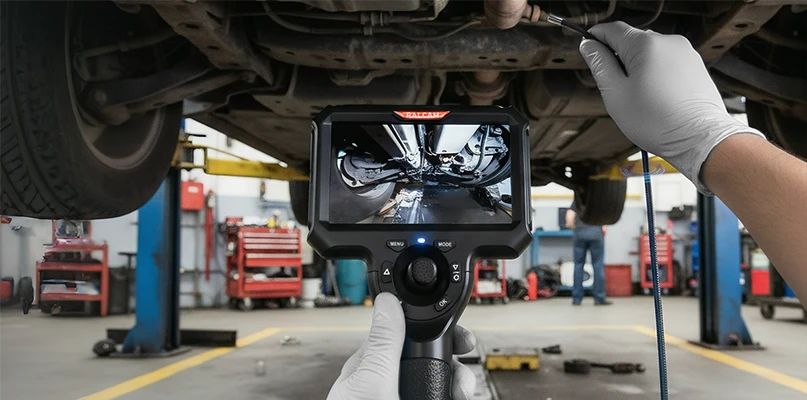
Leave a comment