

Why Every Auto Repair Shop Needs an Endoscope — Not Just the Dealerships
For years, industrial-grade video endoscopes were tools you'd find in OEM dealerships and large fleet maintenance centers. The price point was high, the learning curve was steep, and independent repair shops made do without them. That calculus has changed.
The Diagnostic Gap Endoscopes Fill
Modern vehicles are packed with sensors, computers, and electronic systems that generate fault codes. A scan tool reads the code; the code points to a system. But codes don't tell you why the system failed. That answer is often physical — something is cracked, worn, contaminated, or broken inside a cavity you can't see without either disassembling the component or looking inside it. An endoscope looks inside it.
Cylinder Inspection Without Disassembly
The spark plug hole is the most useful access port in engine diagnostics. Remove the spark plug, insert a 4mm or smaller endoscope probe, and you have a direct view of the piston crown, cylinder wall, and the underside of the intake and exhaust valves.
Scoring on the cylinder wall indicates ring or liner wear. Carbon deposits on the piston crown and valve faces indicate oil consumption or poor fuel quality history. Coolant intrusion leaves residue on the cylinder walls and piston crown. Ring land damage shows up as cracks or collapse in the piston's ring groove area.
Valve and Carbon Deposit Assessment on Direct Injection Engines
Direct injection engines have a well-documented carbon accumulation problem on intake valves. Because fuel is injected directly into the cylinder, the detergent effect of fuel washing over the intake valves is absent. Carbon builds up on the valve face and stem, eventually causing misfires, rough idle, and power loss.
With the intake manifold removed or through an access port in the intake tract, a probe inserted toward the intake valve face shows the degree of carbon accumulation directly. A customer who can see the condition of their own valves on a screen is far more likely to authorize the appropriate service.
Beyond the Engine: Other Automotive Applications
Transmission inspection through dipstick tubes or drain plug openings can reveal clutch pack condition, metal contamination from wear, and fluid degradation that indicates imminent failure.
Exhaust system inspection through the oxygen sensor bung accesses the catalytic converter substrate. Seeing the substrate condition directly prevents unnecessary converter replacement when the problem is elsewhere.
HVAC evaporator inspection through the blower motor cavity can reveal mold growth, debris accumulation, and physical damage without dashboard disassembly.
The Customer Conversation Advantage
When a technician shows a customer an endoscope image of scored cylinder walls, carbon-fouled valves, or a cracked catalytic converter substrate, the service recommendation becomes a shared observation rather than a professional judgment the customer has to take on faith. Authorization rates on high-value repairs are meaningfully higher when the customer has seen the condition directly.
Conclusion
The endoscope is not a specialist tool for specialist shops anymore. It is a diagnostic and communication tool that any repair operation can use to provide better service, more accurate diagnoses, and more persuasive customer communication.
Ready to see inside your engine?
Shop our automotive borescopes — built for precision engine inspection, from spark plug checks to turbo diagnostics.
Shop automotive borescopes →Inspecting engines without teardown?
Explore our automotive borescopes — articulating probes built for cylinders, turbos, and hard-to-reach engine components.
Shop automotive borescopes →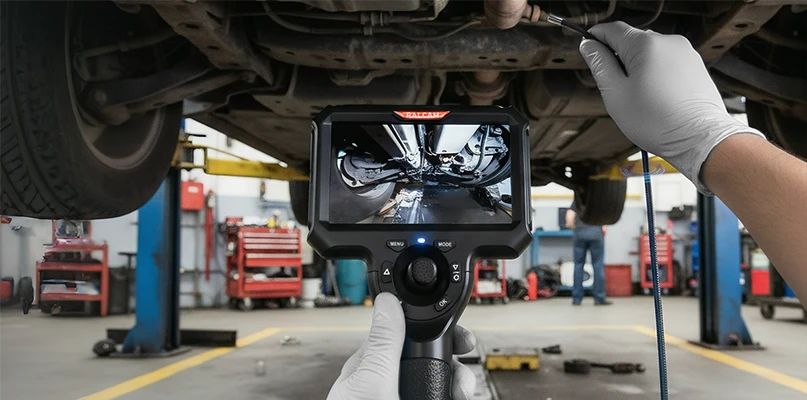
Leave a comment