

Articulating vs Non-Articulating Borescope: Do You Actually Need Steering?
Articulation is the most expensive feature on a borescope, and the one buyers most often overpay for — or, less often, skip when they genuinely needed it. An articulating borescope lets you steer the camera tip from side to side while it is inside a space, aiming the view at whatever you want to see. A non-articulating one does not: you point it by pushing and twisting the whole cable, and the tip looks wherever it happens to look.
That difference is real, but it is not always worth paying for. This guide walks through what steering actually does for you, when a cheaper fixed-tip scope (sometimes with a mirror) is genuinely enough, and when four-way articulation earns its price.
What Articulation Actually Does
Picture inspecting an engine cylinder through a spark plug hole. The wall you most want to examine — for scoring, for a scratch, for a damaged valve seat — is off to the side, not straight ahead of the probe tip.
- With a fixed tip, you see only what is directly in front of the camera. To look sideways you have to physically rotate and reposition the whole cable, and in a confined space you often simply cannot get the angle.
- With an articulating tip, you bend the last centimeter or two of the probe on demand and point the camera at the wall while the rest of the cable stays put.
Articulation converts a scope from "I can see whatever the hole points at" into "I can choose what to look at." In a complex cavity, that is the difference between a real inspection and a lucky glimpse.
Two-Way vs Four-Way Articulation
Not all articulation is equal. There are two common grades:
| Two-way | Four-way | |
|---|---|---|
| Movement | Tip bends along one axis (up/down) | Tip bends on both axes (up/down and left/right) |
| Coverage | Combine the bend with cable rotation to sweep around | Point the tip anywhere in a full cone without rotating the cable |
| In practice | Enough to inspect a cylinder wall or peek around a single bend | Hold a steady view on one feature and study it — valve faces, weld roots, turbine blades |
| Cost | Moderate premium over fixed | Highest — the most complex mechanism |
Two-way articulation covers a surprising amount of real work, because you can rotate the whole cable to turn the single bend axis into effective coverage of a cylinder. Four-way is what you want when you need to hold a precise view on a specific feature — studying each valve face in a combustion chamber, following a weld seam, examining turbine blades one by one. If you find yourself constantly rotating the cable to keep something in frame, that is the job four-way is built for.
When a Fixed-Tip Scope Is Genuinely Enough
Plenty of inspection work does not need steering at all. A non-articulating borescope is the right call when:
- You are looking down a straight path. Pipes, drains, straight bores, wall cavities — you push the probe in and what you need to see is roughly ahead of you.
- The question is presence, not detailed condition. Is there debris, is the part there, is there obvious damage. You do not need to aim precisely to answer those.
- Budget matters and the jobs are varied. A fixed-tip scope costs far less, is mechanically simpler, and has fewer things to break.
There is also a middle path worth knowing about.
The mirror-tip alternative
A side-view mirror attachment clips onto a fixed tip and redirects the view roughly 90°, so you can see the cylinder wall beside the probe instead of only what is ahead. It is a fraction of the cost of articulation and, for straightforward side-viewing tasks, works well.
The catch is that a mirror angle is fixed. Once the probe is in, you cannot change where it points except by rotating or moving the whole cable — you have traded one fixed direction for another fixed direction. For a great many jobs that is a perfectly good trade, and it is worth trying before you pay for a steering mechanism. We cover mirrors and the other add-ons in our guide to borescope accessories.

Articulating vs Non-Articulating: How to Decide
Run your typical job through three questions:
- Is what you need to see off to the side of the probe's path? If it is always straight ahead, you do not need articulation. If it is off-axis, you need articulation or a mirror.
- Do you need to hold a steady, chosen view — or just glance around? A glance is fine with two-way or a mirror. Holding a precise view on a specific feature is where four-way pays off.
- How confined is the space? In open or straight spaces you can aim by moving the cable, so fixed works. In tight, complex cavities — combustion chambers, gearboxes, turbine sections — you cannot reposition the cable freely, and articulation becomes the only way to point the camera.
A quick summary by application:
| Job | What's usually enough |
|---|---|
| Pipes, drains, ducts, straight bores | Fixed tip |
| Wall cavities, general "look and see" | Fixed tip |
| Automotive cylinder walls | Mirror tip or two-way |
| Engine teardown avoidance, gearboxes | Two-way, ideally four-way |
| Turbine, weld root, combustion chamber detail | Four-way |
Don't Forget the Other Specs
Articulation interacts with everything else on the probe. A steering mechanism takes up space inside the tube, so the thinnest probes are usually fixed-tip — if you need both a very small diameter and articulation, expect a narrower and pricier field of options. Our probe diameter guide covers that trade-off, and the broader how to choose a borescope guide puts articulation alongside length, resolution, and lighting so you can weigh them together.
The Bottom Line
Most buyers do not need four-way articulation, and some do not need articulation at all — a fixed tip with a mirror covers a large share of everyday inspection. But if your work involves precise, off-axis viewing inside tight spaces — serious engine, turbine, or weld inspection — articulation is not a luxury, it is the feature that makes the inspection possible. Buy it for the jobs you actually do, not for the spec sheet.
Ready to look at hardware? Our automotive borescope cameras are sized and steered for cylinder and engine work, while the industrial borescope cameras range covers welds, castings, and plant inspection. As a direct-from-factory manufacturer, Ralcam can talk you through whether your jobs justify articulation before you spend on it — tell us what you inspect and we'll give you a straight answer.
Looking for the right borescope?
Browse the full Ralcam range — industrial and automotive inspection cameras for every job.
Shop all borescopes →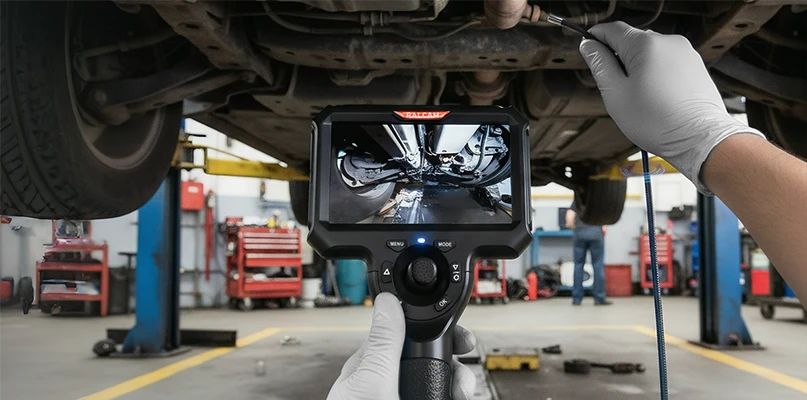
Leave a comment