

Best Borescope for Engine Cylinder Inspection: What to Look For
Engine cylinder inspection is the single most common reason people buy their first borescope. It is also where a poorly matched tool disappoints fastest: the access point is small and awkward, the interior is dark and reflective, and the details you are checking for — scoring, carbon buildup, valve condition — are subtle. Here is what actually matters when choosing a borescope for engine inspection, and why.
Start With the Access Point
On a gasoline engine, the standard access is the spark plug hole. Thread sizes vary — commonly M14, M12, or M10 depending on the engine — and the smaller the plug, the less room the probe has to work with. On a diesel engine, the glow plug hole is typically tighter still.
What this means for probe diameter: most spark plug holes comfortably clear a probe in the 5–6mm class, which is why that size dominates automotive borescopes. If you work on diesels or smaller engines regularly, you may need something closer to 4mm. Measure the specific engines you work on — do not assume. Our probe diameter guide covers this in more depth.
Working Length: Don't Over-Buy
Cylinder inspection is a short-reach job. From the spark plug hole to the piston crown is a matter of centimeters, not meters. A working length of roughly 1 meter is generous for nearly all cylinder work — it gives you slack to route the cable through the engine bay without leaving you fighting several meters of excess cable that does nothing but coil and kink.
Save the long probes for pipes, ducts, and drains. For engines, length is the one spec where more is not better.
Articulation: The Feature That Actually Matters Here
This is where engine inspection differs from a lot of other borescope work. The cylinder wall you want to examine is off to the side of the probe's straight-in path — not directly ahead of the tip. A fixed, non-steering probe shows you whatever happens to be in front of it, which in a cylinder is often not the surface you need to see.
Two ways to solve this:
- Articulating tip. Two-way articulation, combined with rotating the cable, lets you sweep the camera around the cylinder wall and choose your view. Four-way gives finer control, useful if you want to hold a steady view on one specific spot — a valve face, a suspected scratch.
- Side-view mirror attachment. A cheaper fixed alternative that redirects the view roughly 90° so you see the wall beside the probe instead of straight ahead. It works well for a general look around, but the angle is fixed once inserted.
For a one-off "is there obvious damage" check, a mirror tip is often enough. For methodical inspection — checking every cylinder wall section, judging the condition of a valve seat — articulation earns its cost. Our comparison of articulating vs non-articulating borescopes goes through this trade-off in detail.
Lighting: The Spec Buyers Underrate
A cylinder is a closed, dark cavity with no ambient light — everything you see comes from the LEDs on the probe tip. Combustion residue, oil film, and metal surfaces are also highly reflective, which can wash out a poorly diffused light source into hot spots and glare.
Look for:
- Adjustable brightness. A fixed, always-maximum LED often overexposes close-up metal surfaces. Being able to dial it down matters more than raw brightness.
- Multiple LEDs or a diffused light source rather than a single point source, which reduces harsh glare and hot spots on curved cylinder walls.
Cable Stiffness and Sealing
An engine bay is an oily, hot, cramped environment, and the probe has to survive it repeatedly.
- Semi-rigid ("gooseneck") cable is the right choice for engine work — it holds whatever shape you bend it into as you route it past hoses and brackets, unlike a fully flexible cable that just follows gravity.
- Confirm the probe is rated for oil and fuel contact, and check specifically that the probe (not just the handle) carries a waterproof/oilproof rating — the two are often rated differently.
Resolution and Display: Useful, Not Decisive
Resolution matters for cylinder inspection, but only after the constraints above are satisfied — a sharp sensor behind a probe that cannot reach the wall or light it properly does not help. Once diameter, articulation, and lighting fit the job, prioritize a camera that can distinguish fine scoring and surface texture, not just overall shape.
On display type — WiFi, USB, or a built-in screen — personal workflow matters more than the inspection itself. A WiFi model lets you position your phone comfortably while working under the hood; see our comparison of WiFi vs USB vs built-in screen borescopes if you are undecided.
Putting It Together
| Spec | What to look for |
|---|---|
| Probe diameter | Fits your smallest spark or glow plug hole with margin — typically 4–6mm class |
| Working length | ~1 meter is generous; don't over-buy length |
| Articulation | Two-way minimum for methodical inspection, or a mirror tip for quick checks |
| Lighting | Adjustable brightness, diffused rather than single-point LEDs |
| Cable | Semi-rigid, oil/fuel-rated probe |
Next: Doing the Inspection
Once you have the right tool, the technique matters as much as the spec sheet — we walk through the actual inspection process step by step in how to inspect engine cylinders with a borescope. If you are still working through the fundamentals, start with our guide to how to choose a borescope.
Ralcam's automotive borescope cameras are built for exactly this job — sized for spark plug access, articulated for cylinder walls, direct from our factory in Shenzhen. If you are unsure whether a model fits your specific engine, send us the plug thread size and we'll tell you honestly.
Inspecting engines without teardown?
Explore our automotive borescopes — articulating probes built for cylinders, turbos, and hard-to-reach engine components.
Shop automotive borescopes →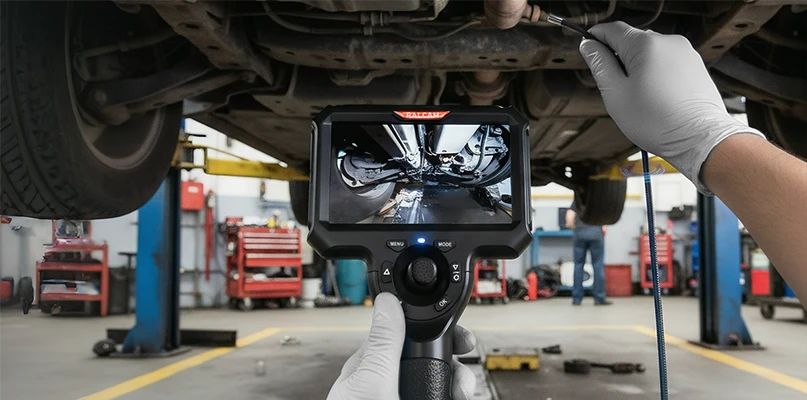
Leave a comment